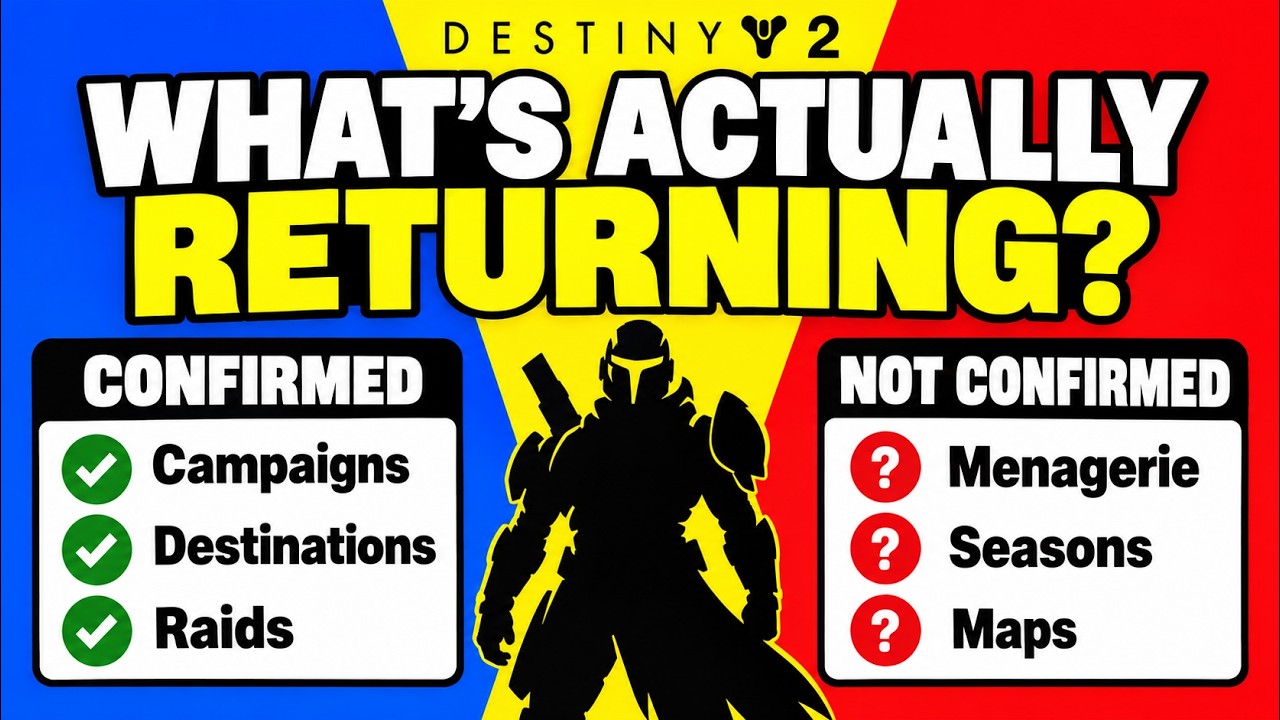
In 2020, Bungie removed Destiny 2's original campaign, and players lost access to content they'd paid for. Six years later, Bungie wants to bring it back. The strange part is that the technical problems that caused the Content Vault haven't gone away. So why the reversal? Start with why the content was removed in the first place.
Why the Content Vault existed 0:24
In 2020, Bungie wanted Destiny 2 to keep growing instead of being replaced by Destiny 3. But:
- The game was already around 115 GB and growing by about 25 GB a year.
- During Season of the Worthy, the Warmind campaign made up just 0.3% of total playtime but took up about 5% of the install size.
- Every new feature had to be tested against years of old content, and every update risked bugs elsewhere.
- A full build of Destiny 2 could take more than 24 hours.
When the engine was upgraded for Beyond Light, things got harder. Former Bungie developer Max Nichols later explained that old activities weren't automatically compatible with the new engine. Anything Bungie kept had to be converted by hand, which cost time, testing and resources.
So Bungie decided to remove older content to make room for new experiences. That was the Destiny Content Vault.
What players lost 1:52
In November 2020, the Red War, Curse of Osiris and Warmind campaigns disappeared, along with destinations including Io, Titan, Mercury and Mars and several raids. In 2022, the Forsaken campaign was removed too.
For Bungie, vaulting lightened the load of maintaining an ever-growing game. For players, it meant losing things they'd bought. And the Red War was Destiny 2's introduction: it set up the characters, the world and the conflict everything else builds on. Without it, new players were starting a story with no beginning, like starting a TV series halfway through season four with no way to watch the earlier episodes.
The slow change of course 2:47
In 2022, Bungie announced it would stop vaulting existing expansions and wanted Destiny 2's story to be playable from start to finish. That didn't restore anything already lost, though.
In May 2026, Bungie announced the game's final planned live-service content update would arrive in June. Then in September 2026, leadership announced that vaulted campaigns, destinations and raids would return, available to all Destiny 2 players.
What changed? 3:52
Bungie's own answer points to how players reacted to the final-update announcement.
Another possible factor is Project Sunrise, a fan-made effort to restore access to older versions of Destiny 2. Using an old game build, its developers have been making lost environments explorable again and building tools for missions and other features. It drew attention shortly before Bungie's announcement.
Did Sunrise influence Bungie? We don't know, and Bungie hasn't confirmed any connection. A restoration this big would take a lot of planning anyway. But Sunrise did show that players hadn't forgotten the removed content.
The technical problems are still there 4:43
In a court filing, Bungie even said the original Red War build can no longer run. Bungie has explained that old content can't just be copied into the current game: it needs updating for today's lighting, enemies and underlying systems. There's been no breakthrough that makes vaulting unnecessary. The work is still there.
What may be different is priorities. In 2020, Bungie was juggling a demanding live-service schedule while constantly expanding the game. With that development cycle finished, restoring old content could become a central focus. That's a plausible explanation, not a confirmed account of Bungie's internal decisions.
Bungie has openly given one more reason: player trust. Leadership admitted the studio lost it. Removing paid campaigns hurt confidence and made Destiny 2 harder to recommend to newcomers. Bringing them back could help repair that, and give new players a proper beginning.
How big will Destiny 2 get? 6:15
- Before Beyond Light, the PC install was listed at up to 116.5 GB.
- After the update, it dropped to about 69.7 GB, a reduction of almost 47 GB.
- Bungie currently lists the Steam install at about 181 GB.
Add 47 GB back and you'd be near 230 GB. But that original reduction wasn't only vaulted content: Bungie also removed obsolete files and changed how data is stored. Some returning assets may already exist, others may be rebuilt, and storage methods could differ. The final size is unknown.
One possible solution is optional downloads, so you'd install old campaigns only when you want them. Bungie hasn't confirmed anything like that, and it wouldn't remove the work of maintaining restored content.
Was the Content Vault a mistake? 7:33
Not necessarily on the technical side. The game's growing complexity was real, and vaulting seems to have helped Bungie manage development. But it had costs you can't measure in gigabytes: players lost content they'd paid for, new players lost the start of the story, and Destiny 2 lost part of its identity.
The real test isn't whether Bungie can bring the Red War back. It's whether Bungie can keep it from disappearing again.
The full walkthrough is on YouTube. Likes and comments help the channel a lot.